

Silicon Tuner Automating the undervolting grind.
Undervolting a GPU by hand is a lot of trial and error: adjust the curve, run a test, check for crashes, repeat. I wanted to see how much power I could save while keeping similar gaming performance, so I built Silicon Tuner to automate that process.
It records a stock baseline, then steps through clock offsets on the voltage/frequency curve and checks each point for errors, building a stability map as it goes. From that map, it derives three profiles with different goals: Efficiency, Balanced and Maximum Performance. Profiles can then be validated in actual games, not just synthetic tests.
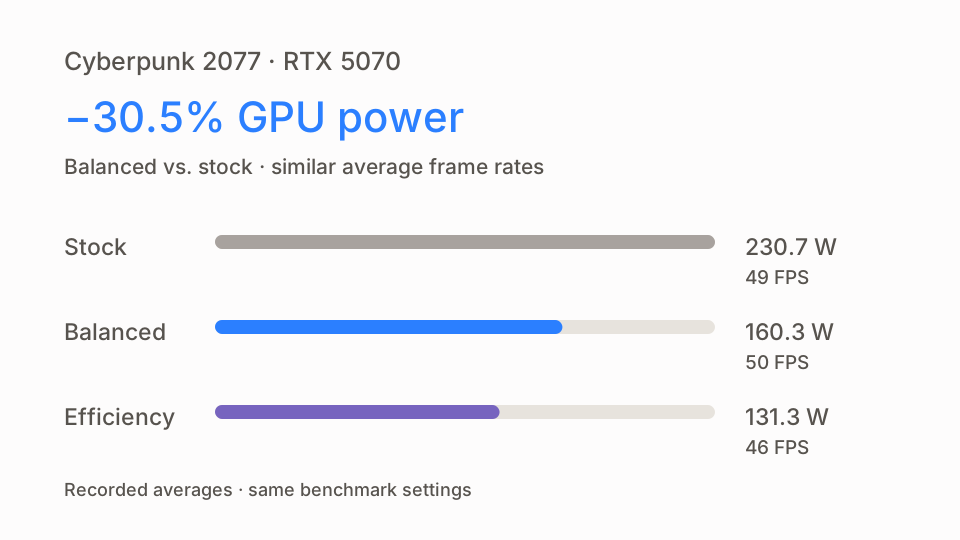
I've tested it on my RTX 5090 and RTX 5070. For the RTX 5070 results shown here, I ran Cyberpunk 2077's built-in benchmark with the same game settings for each profile and compared power draw, frame rate and temperature against stock.
- Balanced: 30.5% less power
- 160.3 W against 230.7 W at stock, averaging 50 FPS versus 49 and running 9.8 °C cooler in my runs.
- Efficiency: the biggest saving
- 131.3 W, about 43% less than stock, at 46 FPS. A larger power cut in exchange for a few frames.
- Your mileage will vary
- Different GPUs respond differently to the same settings, and passing one test doesn't guarantee stability in every workload. These numbers come from one card in one benchmark, not a promise for every GPU.
Average GPU power Lower is better
Average frame rate Higher is better
| Profile | GPU power | GPU temp. | Avg. FPS |
|---|---|---|---|
| Stock | 230.7 W | 79.4 °C | 49 |
| Balanced | 160.3 W | 69.6 °C | 50 |
| Efficiency | 131.3 W | 65.4 °C | 46 |
Recorded averages from my RTX 5070 runs using Cyberpunk 2077's built-in benchmark, with the same game settings for each profile. They show the power/performance trade-off on this card and workload, not a guaranteed result for other GPUs or games.
Seeing the trade-off in motion
I also recorded the profiles on my RTX 5090, in Cyberpunk 2077 and Resident Evil Requiem. Each video shows Stock, Balanced and Efficiency side by side, with live power, temperature, clock and frame-rate overlays.
These are separate tests from the RTX 5070 results above, and the power savings shown on the 5090 are smaller. That's a big part of why I treat each result as specific to the card and game it was measured on.
Open the full videos: Cyberpunk 2077 · 1:06 · Resident Evil Requiem · 0:50. The overlays describe these recordings only; they aren't a guarantee of savings, identical frame rates or stability in other games.